Showing posts with label Homework help. Show all posts

Tuesday, March 19, 2013

Polygons


Measurement


OK, sorry this has taken so long.  Here it is, all my Measurement materials in one big post.  This will include our class foldables as well as anchor charts.  Sorry if anything is repeated.

Monday, March 18, 2013

Combinations


Points, Lines, and Angles


We started our Geometry unit today by creating our Point, Lines, and Angles foldable.  They will use this throughout the unit.  I explained to the students today, we will not measure angles in fourth grade.  But, we will have to identify angles within a 2D figure.  As well as identify parallel and perpendicular lines within 2D figures.

Monday, February 4, 2013

Converting Measurement


We are learning about Units of Length this week.  We are also learning how to convert customary units of length.  We learned a song to help us.

Saturday, November 10, 2012

Relationship Tables


In and Out Charts as we like to call them.  I started the lesson with my "Magic Machine".  The kids love to guess what happens in my magic machine.  (As you can tell, I DO NOT draw well.)  The magic machine does something to a number that causes it to come out differently.  My machine never changes its "RULE" though.  It always does the same thing.  The same is true in a relationship table.  The rule will never change.  We study these charts or tables during our multiplication and division unit because depending on the way you read the labels of the table, the operation or rule would be effected.  In the example above, TRIANGLE x3 = SQUARE or you could say the opposite SQUARE /3 = TRIANGLE.  Also you will notice going from a small number to a large number is multiplication and from a large number to a small number is division.  (We will hit this concept again when converting.)

Multiplication Songs


Often times it is difficult for students to recall their multiplication facts.  We encourage students to look at multiplication as patterns in numbers, or skip counting, and picture the multiplication chart in their head.  However, this concept is still difficult for some.  Song is often a very effective way of memorization.  I did not create these, but I do teach these in my class and have made posters to hang in the hall for the students to see when in line or at restroom break.  They are all set to familiar tunes, except maybe the eights.  Most kids don't know that song anymore.

Thursday, November 8, 2012

MORE Division


Here are two posters that explains the process of division.  The students are free to choose which ever method they feel comfortable with.  We only encourage that they stick to one particular method.

Monday, November 5, 2012

Tower of Power

Okay, here is it.  Division the "funny way".  The theory behind this method is that division is connected to multiplication and repeated subtraction.  With this method, it doesn't matter which facts you remember, you will eventually get to the end.  This is very helpful to students that do not know their facts.  The goal is to take big chunks away from the dividend (the number under the house).  Your final quotient is found by adding up all of your factors and including the remainder.  Check by multiplying!

Division

Sorry for the brief delay in division information.  The district has been updating the system and I was blocked from my blog site.  Above you will see how we relate multiplication to division.  They are opposite operations.  Division cannot be solved apart from multiplication.  Dividing is simply putting total amounts into groups equally, you may or may not have any left over.  In my previous post was showing the connection between the two operations.

Thursday, November 1, 2012

Division


We connected the model with manipulatives to the algorithm.  The steps are Divide, Multiply, Subtract, and then Bring down.  If there are no more numbers to bring down, that is your remainder.  The remainder can never be larger than the number you are dividing by.

Wednesday, October 17, 2012

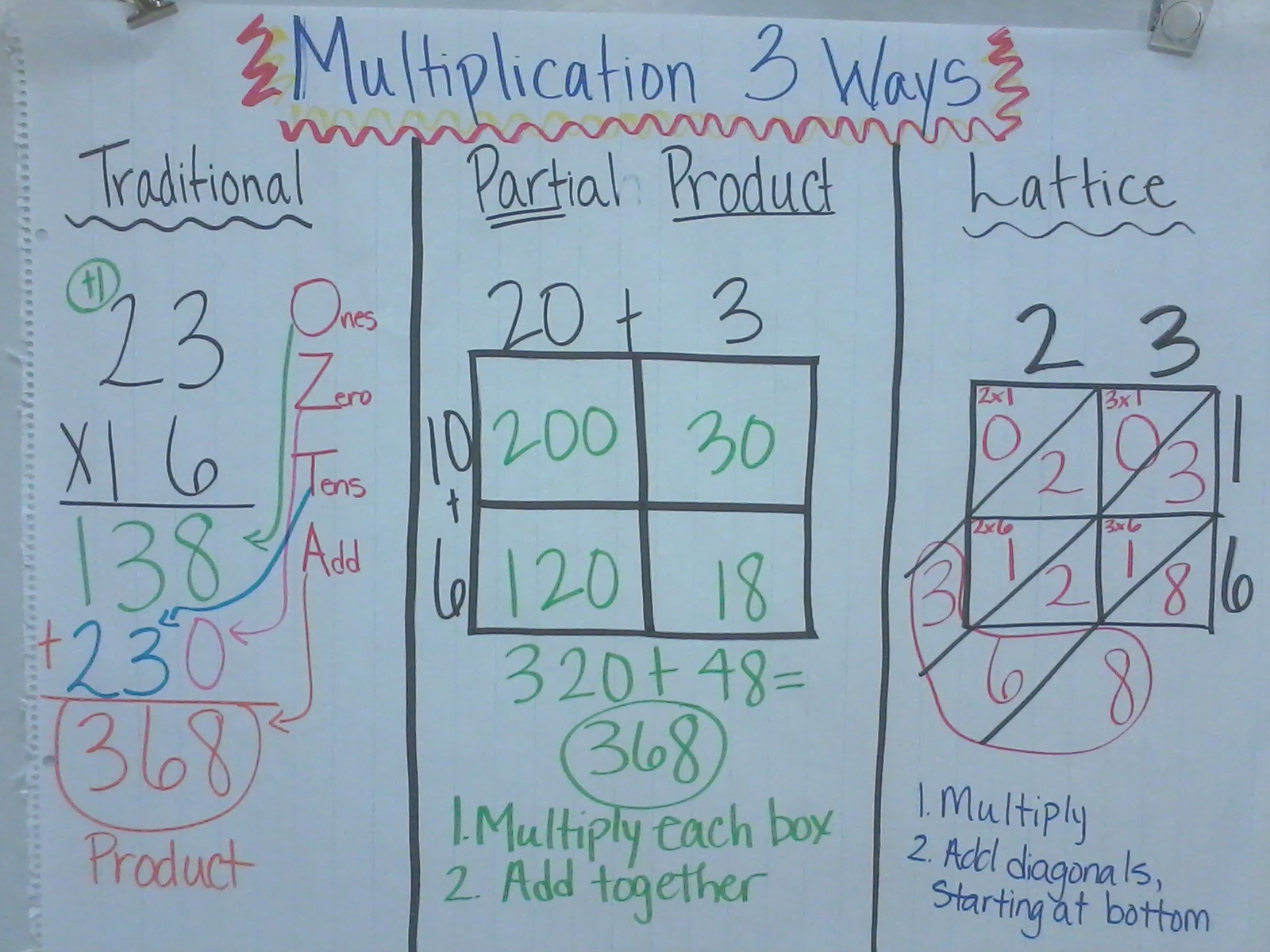
3 Ways to Multiply

Today we practiced and practiced, and practiced some more.  Each student chose for themselves which of the three methods was easiest for them.  Check out our poster!

Tuesday, October 16, 2012

2 Digit x 2 Digit


There are several ways to find a product.  We learned 2 ways today; traditional and partial product. 
For the traditional method, I taught the students to say "OZTA" which stands for Ones, Zero, Tens, Add.  It helps them to not get lost in the process.
For partial product, the students write each number in expanded form and then multiply and then add the products.  They are taking the number apart and then putting it back together. 


Wednesday, October 10, 2012

Multiplying Across Zeros


We got this!  We completed a journal entry on how to multiply across zeros today.  It will be our easiest multiplication lesson ever.  We even got to prove it on a calculator!  Check it out! Find the basic factors and multiply then add the zeros to the end.


Thursday, October 4, 2012

What do you want me to do???????

How do I know when to add or subtract?  Oh, those word problems.  Questions in Math have changed over the years.  No longer are there "Key Words" like altogther, total, each, separate, etc.  The key words have been removed and the students have to recognize real world situations.  Therefore, we made a poster to help identify situations.  When this happens in the story, we will . . . . .  Check out our poster!

Monday, October 1, 2012

Which will float?


Today we completed our final mixture; woodchips, pebbles, and water.  We predicted which solid would float and then combined our mixture.  We stirred it up and allowed it to settle. Then we observed at eye level to determine which solid would sink and which would float.  The pebbles are more dense than the water, so they sank.  The woodchips were less dense, so they float.  We got our hands wet separating the mixture back to its original form. 

Multiplication Chart

Today we made the X chart SOOOOO much easier.  We did what we KNOW for a fact: 0, 1, 2, 5, 10, 11 in orange.  Wow!  Look how much of the chart is complete.  Now we went down the middle with prime numbers. EX: 0 x 0, 1 x 1, 2 x 2.  Then we highlighted the factor on bottom in yellow and crossed off its communicative property on top.  EX: 3 x 6 = 18 so 6 x 3 = 18.  We really only need to know less than half of the chart!

Wednesday, September 26, 2012

Math Charts


Above are some charts that we made in class.  These posters hang on the wall as long as we are studying that particular concept.  I am posting them here in the case that your child finds them helpful while completing homework.